Nordic report on the impacts of a AMOC tipping urges stronger mitigation, monitoring and preparedness
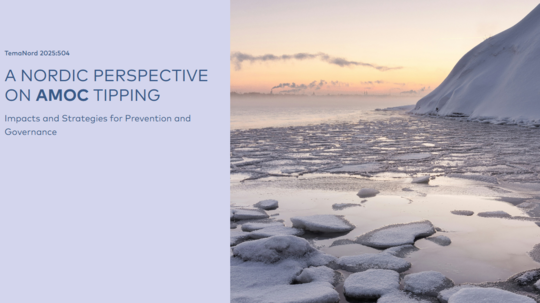
The report A Nordic Perspective on AMOC Tipping reviews the current state of science on the impacts of potential Atlantic Meridional Overturning Circulation (AMOC) collapse and provides recommendations for policy actions.
The report was published on Thursday 5 February 2026 on the Nordic Council's website: https://pub.norden.org/temanord2026-504.
The Atlantic Meridional Overturning Circulation (AMOC) transports heat to the North Atlantic and contributes to the relatively mild climate of the Nordic countries. Global warming is slowing down AMOC and although unlikely, it is possible that it could even stop at relatively low levels of global warming. Such a change could turn the climate of Northern Europe in a colder direction while the rest of the world continues to warm – the effects could be visible in food production, energy systems, and livelihoods, among other things.
“The AMOC is a key part of the climate system for the Nordic region. While the future of the AMOC is uncertain, the potential for a rapid weakening or collapse is a risk we need to take seriously,” says Aleksi Nummelin, Research Professor at the Finnish Meteorological Institute.
“This report brings together current scientific knowledge and highlights practical actions for mitigation, monitoring and preparedness.”
Key messages from the report
- It is vital to push for vigorous mitigation that achieves decarbonization and net negative emission targets. Until we have better understanding of the likelihood of AMOC crossing a critical threshold (tipping point), and the level of global warming or timeframe at which this might occur, a precautionary approach should be assumed: Any additional warming, and any increase in duration of “overshoot” of 1.5°C increases the risk of AMOC collapse. Therefore, preventing further warming is crucial.
- Long-term funding should be secured to sustain and operationalize key observational networks, and build an AMOC early warning system that couples Earth observations with model simulations. This early warning system should be embedded in policy making processes to create rapid knowledge-to-action abilities. The new EU Ocean Act provides possibilities for coordinating this effort.
- The future of the AMOC is highly uncertain, but an AMOC collapse could trigger extreme impacts in the Nordic countries that differ from, and in part oppose, those expected from global climate change. It is essential to develop and adopt flexible climate change adaptation strategies that account for the region's exposure to the impacts of AMOC weakening and would succeed across divergent future trajectories with and without AMOC tipping. Further, the potential collapse of the AMOC should be treated as a real and significant threat, to which comprehensive risk management frameworks are applied and integrated across all levels of governance.
Report brings together Nordic and international expertise
The report was initiated at the Nordic Council of Ministers sponsored ‘Nordic Tipping Week' workshop, arranged on 21–24 October 2025 in Helsinki and Rovaniemi, Finland, as part of Finland's Council Presidency theme resilience. The workshop brought together scientists working on different aspects of AMOC dynamics and its impacts, from physical oceanographers to social scientists.
The report was prepared in collaboration with scientists from a wide range of Nordic and international research institutions. The Finnish Meteorological Institute coordinated the work.
The workshop, and this report, were in part motivated by the Open Letter by Climate Scientists to the Nordic Council of Ministers presented in 2024. The letter suggested that the risk of an AMOC collapse might have been previously overlooked.