News
New risk assessment for people's safety in Grindavík available on the municipality's website
Situation on the Reykjanes Peninsula
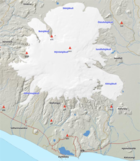
Increased electrical conductivity and gas pollution at Múlakvísl
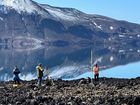
Measurements show that uplift at Askja has ceased
Measurements by the lake in Askja. Fieldwork in the area was completed this week, and the results indicate that the uplift episode that began in 2021 has ended.
Read moreIncreased hazard due to changing conditions at the margin of Sólheimajökull glacier
Recent changes at the terminus of Sólheimajökull call for increased caution. Unstable glacier ice and rockfall from the surrounding slopes may pose a risk to people visiting the area.
Read more
Ground uplift and magma accumulation continue beneath Svartsengi
The Icelandic Met Office receives international grant to strengthen aviation safety in relation to volcanic hazards
In October 2025, the Icelandic Meteorological Office (IMO) received a grant of ISK 147 million from the International Civil Aviation Organization (ICAO) for four new development projects in the fields of volcanic hazards and aviation safety. The projects involve, among other things, the development of new measurement methods, automatic analysis of eruption plumes, coordination of responses among European volcano observatories, and research into the effects of sulphur dioxide (SO₂) on aviation.
Read more
IMO expert to lead international collaboration on geohazards

Nordic report on the impacts of a AMOC tipping urges stronger mitigation, monitoring and preparedness
The report A Nordic Perspective on AMOC Tipping reviews the current state of science on the impacts of potential Atlantic Meridional Overturning Circulation (AMOC) collapse and provides recommendations for policy actions.
Read moreThe weather in Iceland in 2025
The year 2025 was the warmest year in Iceland since measurements began. The national average temperature was 5.2 °C, which is 1.1 °C above the average for the years 1991–2020 and the highest ever recorded. Temperatures were well above average for almost every month of the year. The spring weather was exceptionally favourable; it was the warmest spring ever recorded nationwide, and May was by far the warmest May on record. In mid-May, a 10-day heatwave occurred across the entire country. It was the most significant heatwave known in Iceland for the month of May. Overall, the weather in 2025 was unusually calm, with few stormy days and generally favourable conditions. It was relatively wet at the beginning of the year but dry toward the end. Snow cover was light across the entire country.
Read more
SeisComP becomes the new primary earthquake monitoring system of the Icelandic Meteorological Office
The implementation of SeisComP represents a major step forward in the development of the IMO's earthquake monitoring capabilities. Preparations have been underway for several years, and the system transition involves both technical and procedural changes aimed at improving analytical capability, data dissemination, and providing a more modern working environment for specialists.
Read moreSearch
Contact IMO
© Veðurstofa Íslands | Bústaðavegi 7- 9 | 105 Reykjavík | Phone 522 6000 | Fax: 522 6001
Recording 902 0600 | SSN 630908-0350
Contact us | Employees | Terms and conditions | Sitemap