The Icelandic Met Office receives international grant to strengthen aviation safety in relation to volcanic hazards
In October 2025, the Icelandic Meteorological Office (IMO) received a grant of ISK 147 million from the International Civil Aviation Organization (ICAO) for four new development projects in the fields of volcanic hazards and aviation safety. The projects involve, among other things, the development of new measurement methods, automatic analysis of eruption plumes, coordination of responses among European volcano observatories, and research into the effects of sulphur dioxide (SO₂) on aviation.
The common objective of the projects is to improve monitoring and the dissemination of information related to volcanic hazards, thereby reducing risks to aviation, particularly over the North Atlantic. The grant also underlines IMO's international role as Iceland's State Volcano Observatory (SVO) and the importance of Icelandic expertise in the field of volcanic hazards.
The Icelandic Meteorological Office was formally designated as Iceland's State Volcano Observatory in 2010 by the Icelandic Transport Authority, then the Icelandic Civil Aviation Administration, following the Eyjafjallajökull eruption. With this designation, IMO was given the responsibility of reporting on volcanic unrest and eruptions in Iceland to the London Volcanic Ash Advisory Centre (VAAC), to other VAACs as needed, and to the aviation community more broadly, in accordance with ICAO regulations.
IMO is responsible for monitoring, forecasting and issuing warnings for natural hazards in Iceland, including volcanic activity in the country's active volcanoes and volcanic systems.
The four development projects are as follows:
Calibrated Digital surveillance-camera Network at Jan Mayen for Volcanic plume height assessment (CamJan)
This project aims to develop an automated system for detecting, measuring, and distributing information related to volcanic plumes that may form during eruptions at Jan Mayen volcano in Norway. At present, monitoring capabilities for assessing volcanic activity on the island are limited. To enhance these capabilities, IMO will establish a network of calibrated cameras, which will supplement the sporadically available satellite data in this region. The project is expected to result in the implementation of new operating procedures for the surveillance of Jan Mayen volcano.
Digital Twin for Improved Eruption Source Parameters Assessment and Forecasting Capabilities of Atmospheric Volcanic Hazards from Icelandic Volcanoes (DigiVolc)
This project is proposed as a significant enhancement
to the aviation safety architecture in the North Atlantic region. It is centred
on the creation of an operational Digital Twin (DT) at the IMO, which will
allow the near-real-time quantification of eruption source parameters (ESPs).
These parameters are critical for the reliable forecasting of volcanic ash
clouds, which can pose severe and widespread hazards to aviation. In practice,
ESPs define the starting conditions for dispersal models used by Volcanic Ash
Advisory Centres, and their accurate assessment is fundamental for mitigating
risks to international air navigation. By constructing a DT that integrates
multiple streams of observations – including ground-based instrumentation,
satellite retrievals, and calibrated camera networks – with advanced modelling
capabilities, IMO will provide robust and timely ESP estimates for several
potentially hazardous volcanoes. These estimates will be accompanied by
uncertainty assessments, thereby enabling the aviation sector to operate with
greater confidence and precision.
Common Procedures and Operational Standards Within the European Volcano Observatory Network (EVON-avi):
This project is designed to harmonise the way European Volcano Observatories (VOs) provide critical information to the aviation sector during volcanic crises. At present, significant variation exists in how volcanic plume-heights are assessed, aviation colour codes are applied, and VONAs (Volcano Observatory Notices for Aviation) are formatted and disseminated. These inconsistencies can create operational uncertainty for Volcanic Ash Advisory Centres, Meteorological Watch Offices, Air Navigation Service Providers, and airlines, particularly in the North Atlantic region where eruptions in Iceland and the Azores regularly influence some of the busiest transatlantic flight corridors. EVON-avi will address these shortcomings by developing common guidelines for plume height estimation, establishing technical training in the use of calibrated cameras and IWXXM-formatted VONAs, and coordinating the maintenance of an updated European Catalogue of Volcanoes.
EVON-avi project builds on the existing European Volcano Observatory Network which currently comprises the Icelandic Meteorological Office (IMO), Istituto Nazionale di Geofisica e Vulcanologia (INGV, Italy), Instituto Geográfico Nacional (IGN, Spain), Instituto de Investigação em Vulcanologia e Avaliação de Riscos / Centro de Informação e Vigilância Sismovulcânica dos Açores (IVAR-CIVISA, Azores, Portugal), and the Royal Netherlands Meteorological Institute (KNMI).
Volcanic Sulphur Dioxide Encounters (VOSDE): Towards the mitigation of volcanic SO₂ hazards for improved aviation safety:
This project will establish, analyse, and set into an operational framework a unique dataset of in-flight encounters with volcanic sulphur dioxide (SO₂). Despite increasing recognition of volcanic gas as a threat to aviation, the global aviation sector lacks a robust dataset and experience-based exposure thresholds for SO₂ hazards. The VOSDE project addresses volcanic SO2 hazards that can affect international flight levels across the North Atlantic, a critical region for global civil aviation. This will be achieved by analysing volcanic SO2 emissions from Iceland. While recent eruptions on the Reykjanes Peninsula since 2021 have demonstrated this hazard locally, these events underline the potential for volcanic SO₂ clouds to intersect enroute traffic in the wider North Atlantic airspace. The results of the project will be used to assess whether there is a basis for issuing SIGMET warnings for SO₂ emissions from volcanic eruptions, thereby supporting the development of international preparedness and response procedures for volcanic gas hazards within the framework of the International Airways Volcano Watch (IAVW).The project will strengthen both aviation safety and aviation security, ensuring that passengers, crews, aircraft, and flight routes are better protected during prolonged volcanic crises.
A survey related to the project has been launched: Survey on volcanic sulphur dioxide hazards and aviation safety.
A total of
nine IMO staff members is involved in the ICAO development projects, which will
run for one to three years. The projects further strengthen IMO's international
role in the fields of volcanic hazards and aviation safety, building on the
knowledge and experience gained from volcanic eruptions in Iceland in recent decades.
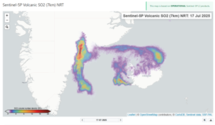
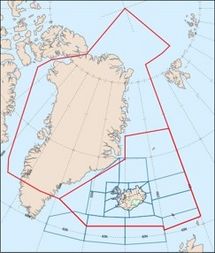
Figure on the left show's distribution SO₂ from a volcanic eruption on the Reykjanes Peninsula on 17 July 2025, as detected by Sentinel-5P (ESA, 2025). Figure on the right shows Reykjavík Flight Information Region – Iceland's area of responsibility for aviation safety across the North Atlantic.